

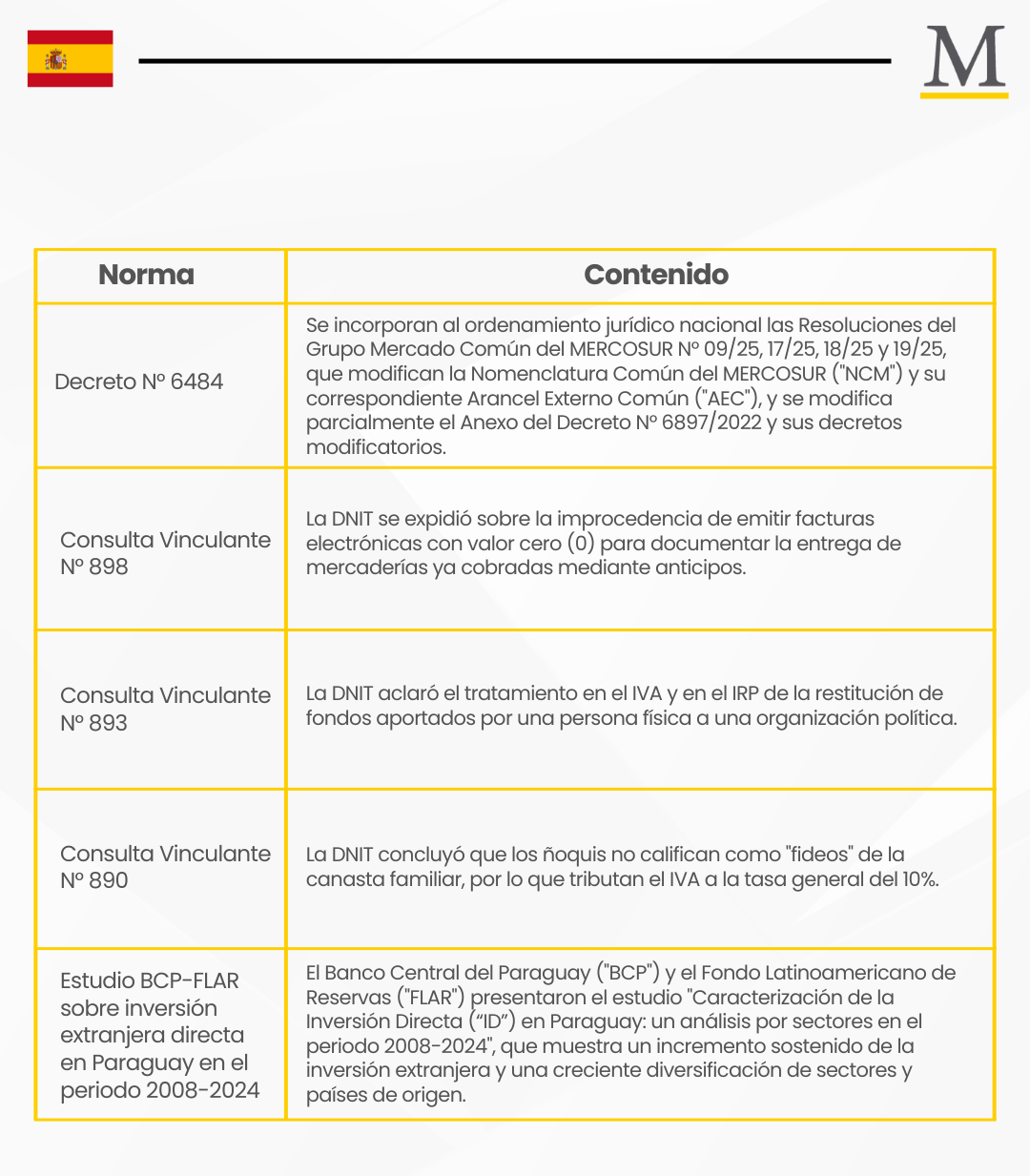
► Decreto N° 6484/2026 – Se incorporan al ordenamiento jurídico nacional nuevas modificaciones de la Nomenclatura Común del MERCOSUR y del Arancel Externo Común.
Por medio del Decreto N° 6484 del 3 de agosto de 2026, el Poder Ejecutivo incorporó al ordenamiento jurídico nacional las Resoluciones del Grupo Mercado Común del MERCOSUR («GMC») N° 09/25, 17/25, 18/25 y 19/25, todas ellas denominadas «Modificación de la Nomenclatura Común del MERCOSUR y su correspondiente Arancel Externo Común». Con ello se modificó parcialmente el Anexo del Decreto N° 6897/2022, que es la norma que consolida la NCM y el AEC vigentes en el país. Conforme a su artículo 7°, el decreto entró en vigor a partir de su publicación.
Las modificaciones son de carácter técnico-arancelario y consisten, principalmente, en la creación de nuevas aperturas (códigos NCM específicos) y en el ajuste de descripciones de partidas. Entre las novedades se destacan las nuevas aperturas con AEC del 0% para preparaciones con contenido de vitamina B12 destinadas a la alimentación animal, para recipientes (cápsulas) de aluminio para el envasado de café y productos similares, de los tipos utilizados en máquinas de preparación de bebidas, y para aparatos destinados a procedimientos quirúrgicos asistidos por robótica.
Asimismo, se crean aperturas específicas para identificar determinadas sustancias controladas por la Convención de Róterdam, conforme a la recomendación de la Organización Mundial de Aduanas del 26 de junio de 2025 (los ácidos perfluorooctanoicos y sus sales, y el terbufós); y se incorporan nuevas aperturas, todas con AEC del 0%, para el mineral de hierro en briquetas de entre 4 y 60 cm³, para el mesilato de dabrafenib (que se suma a la lista de medicamentos oncológicos y antirretrovirales con arancel cero) y para los cascos de seguridad de los tipos utilizados por bomberos, con visor y protector facial incorporados (el resto de los cascos de seguridad mantiene el AEC del 20%). Se ajustan, además, las aperturas de ciertos polímeros (HPEG), tejidos utilizados como soportes para la fabricación de lijas, tubos de acero, polvos de cobre, antenas para estaciones base de telefonía celular y partes de máquinas.
Cabe señalar que, a nivel MERCOSUR, la Resolución GMC N° 09/25 previó su entrada en vigor el 1 de octubre de 2025 (01/X/2025), mientras que las Resoluciones GMC N° 17/25, 18/25 y 19/25 la previeron para el 1 de febrero de 2026 (01/II/2026), debiendo los Estados Partes incorporarlas a sus ordenamientos antes de esas fechas; en el Paraguay, no obstante, las modificaciones rigen desde la publicación del Decreto N° 6484/2026. Los importadores deberán revisar la correcta clasificación arancelaria de sus productos a la luz de estas modificaciones.
► Consulta Vinculante N° 898 – No corresponde emitir facturas electrónicas con valor cero (0) para documentar la entrega de mercaderías ya cobradas mediante anticipos.
Una contribuyente de la categoría de Grandes Contribuyentes consultó a la DNIT sobre la procedencia de su modalidad operativa, consistente en emitir una factura electrónica por los cobros anticipados a cuenta de productos (reconociendo en ese momento el débito fiscal del IVA) y, al momento de la entrega parcial o total de las mercaderías, emitir una segunda factura «de liquidación» asociada a la del anticipo, cuyo «total importe a pagar» resulta cero, a fines de control de inventario y respaldo documental.
La DNIT respondió que esta práctica no es procedente. Con base en el numeral 3) del artículo 6° del Decreto N° 872/2023, en las operaciones con anticipos debe emitirse la factura electrónica por el monto recibido y, al cerrarse el precio, realizar la liquidación final y emitir la factura electrónica únicamente por la diferencia, si existiere, asociándola a la factura del anticipo. Un documento con valor cero no respalda ninguna transacción comercial, tributaria ni financiera válida.
En cuanto al traslado de las mercaderías, la DNIT indicó que la manera adecuada de documentar las entregas parciales es la asociación de una o varias Notas de Remisión Electrónicas a la factura que documentó el anticipo o, en su caso, el registro del «evento de transporte» previsto en el artículo 32 del Decreto N° 872/2023 para modificar o complementar la información del traslado.
► Consulta Vinculante N° 893 – Tratamiento tributario de la restitución de fondos aportados a una organización política.
Una persona física consultó sobre el tratamiento tributario aplicable a la recuperación de fondos propios que había adelantado a una organización política, cuya restitución fue aprobada posteriormente por los órganos competentes de dicha entidad.
La DNIT concluyó que la devolución del capital aportado se encuentra fuera del objeto del IVA, pues no existe enajenación de bienes ni prestación de servicios, por lo que no genera débito fiscal para la consultante ni crédito fiscal para la organización política. Respecto del IRP, la restitución tampoco constituye un ingreso gravado, siempre que los aportes hayan provenido de rentas debidamente declaradas en dicho impuesto; en cambio, si el aporte hubiera sido deducido en su momento, su restitución constituirá una renta gravada. Cualquier concepto adicional percibido, como intereses, sí estará gravado por el IVA y el IRP. Finalmente, la operación debe documentarse mediante la factura correspondiente, conforme al artículo 92 de la Ley N° 6380/2019.
► Consulta Vinculante N° 890 – Los ñoquis no son «fideos» de la canasta familiar y tributan el IVA a la tasa del 10%.
Una empresa elaboradora de pastas consultó si sus fideos precocidos y pasteurizados, así como los ñoquis, pueden tributar el IVA a la tasa reducida del 5% prevista para los «fideos» de la canasta familiar (artículo 90, inciso c, de la Ley N° 6380/2019 y artículo 23, numeral 2, del Decreto N° 3107/2019, que comprende los «fideos no cocinados, frescos o secos, de cualquier tipo»).
Respecto de los ñoquis, la DNIT concluyó que no corresponde la aplicación de la tasa reducida, debiendo tributar a la tasa general del 10%. Sostuvo que las tasas reducidas constituyen un beneficio fiscal de interpretación restrictiva, no admisible por analogía; que los ñoquis se elaboran fundamentalmente a partir de papa, con un proceso y composición sustancialmente distintos a los de los fideos; y que en el uso común y comercial no se identifican como tales. Este pronunciamiento confirma el criterio restrictivo de la Administración Tributaria en la delimitación de los productos de la canasta familiar beneficiados con la tasa del 5%.
► El BCP y el FLAR presentaron el estudio «Caracterización de la Inversión Directa (ID) en Paraguay» para el periodo 2008-2024: la inversión extranjera se incrementó de manera sostenida y se diversificó por sectores y países de origen.
El 6 de agosto de 2026, el Banco Central del Paraguay y el Fondo Latinoamericano de Reservas presentaron el estudio «Caracterización de la Inversión Directa (“ID”) en Paraguay: un análisis por sectores en el periodo 2008-2024», elaborado con información a nivel de empresa compilada por el BCP. El estudio concluye que la ID fue una fuente sostenida de financiamiento externo para el país, con flujos netos promedio de USD 590 millones anuales (1,6% del PIB) durante el periodo analizado.
La inversión extranjera efectivamente se incrementó a lo largo del periodo estudiado.Los flujos brutos de entrada pasaron de un promedio de USD 1.566 millones anuales en 2008-2011 a USD 2.369 millones en 2012-2015, USD 2.555 millones en 2016-2019 y USD 2.994 millones en 2020-2024, siendo este último el subperiodo de mayor dinamismo, impulsado por el comercio, la intermediación financiera, la elaboración de aceites y el transporte. En 2024 el flujo neto fue de USD 931 millones (2,1% del PIB), uno de los niveles más altos de la serie. La capitalización de las empresas con ID pasó de USD 244 millones en 2008 a USD 561 millones en 2024, y las utilidades reinvertidas crecieron de USD 211 millones a USD 429 millones. Predominaron las inversiones «greenfield» (creación de nuevos proyectos y activos) en 13 de los 17 años, aunque en 2024 las inversiones «brownfield» (adquisición o ampliación de empresas existentes) alcanzaron su récord, con USD 574 millones.
Por sectores,los servicios no financieros fueron el principal receptor, con el 44% de los flujos netos acumulados del periodo (cerca de USD 4.400 millones), liderados por el comercio al por mayor, las actividades inmobiliarias, las telecomunicaciones, la venta de vehículos y el transporte fluvial. Le siguió la manufactura, con el 26% (unos USD 2.640 millones), destacándose el procesamiento de carne, la elaboración de aceites y grasas, los productos de metal, farmacéuticos, bebidas, autopartes y fertilizantes, varias de estas actividades favorecidas por regímenes de incentivos como la maquila; el número de empresas manufactureras con ID pasó de 74 en 2008 a 334 en 2024. Los servicios financieros captaron el 20% (unos USD 1.960 millones, concentrados en bancos, financieras y aseguradoras) y son el sector más rentable según este informe, con un retorno promedio cercano al 20%. El sector primario tuvo la menor participación (10%, cerca de USD 1.000 millones), aunque con expansión reciente en la silvicultura y la ganadería.
En cuanto al origen de la inversión,el estudio constata una creciente diversificación: los países inversores pasaron de 39 en 2008 a 68 en 2024. En el periodo 2008-2015 las principales inversiones provinieron de Brasil (17,3%), Estados Unidos (11,6%), España (11,4%), Argentina (6,4%) y Países Bajos (5,4%). En 2016-2024, Brasil (21%), Estados Unidos (12,5%), Islas Caimán (8,5%) y Países Bajos (6,5%) se consolidaron como actores clave, y ganaron peso los socios regionales: Uruguay (5,9%), Argentina (5,8%), Chile (5,8%) y Colombia (3,9%).
El estudio concluye que, si bien Paraguay avanzó significativamente en la creación de un entorno propicio para la atracción de inversiones mediante reformas institucionales y regulatorias, persisten desafíos en materia de previsibilidad regulatoria, eficiencia institucional, infraestructura y encadenamientos productivos, por lo que recomienda continuar con políticas orientadas a diversificar la estructura productiva y promover actividades de mayor valor agregado.
EQUIPO DE CONTACTO:
Tomás Mersán – socio | tomasmersan@mersanlaw.com
Horacio Sánchez – socio | horaciosanchez@mersanlaw.com
Sebastián Pérez – socio | sebastianperez@mersanlaw.com
Federico Martínez – asociado senior | federicomartinez@mersanlaw.com
Diana Rolón – asociada | dianarolon@mersanlaw.com
Martina Conti – asociada | martinaconti@mersanlaw.com
Consulta la Newsletter de Novedades Tributarias de julio y conoce más sobre los servicios de Derecho Tributario de MERSAN.