

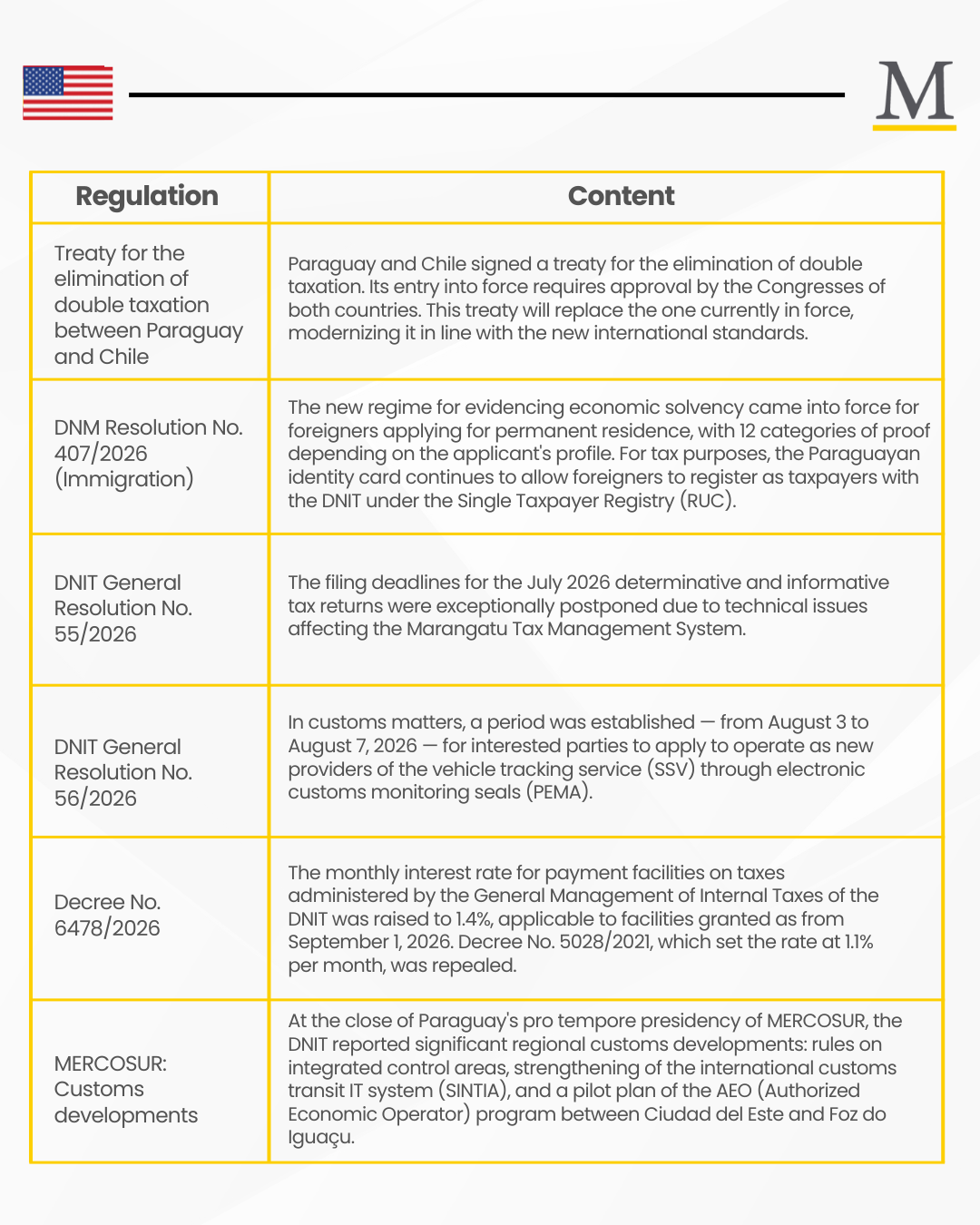
► Paraguay–Chile Double Taxation Treaty — New treaty signed on 1 July 2026.
During the official visit of Chile’s President to Paraguay in July 2026, the foreign ministers of both countries signed, in Asunción, a treaty to eliminate double taxation and prevent tax evasion and avoidance with respect to income and wealth taxes (the “Treaty”). Paraguay’s National Directorate of Tax Revenue (“DNIT”) took part in the technical negotiation of the instrument, together with the Ministry of Foreign Affairs and the Ministry of Economy and Finance.
The Treaty follows OECD and UN international standards on the allocation of taxing rights between States, and includes provisions on the prevention of treaty abuse, exchange of information between tax authorities, and mutual assistance in tax collection.
Its purpose is to prevent the same income or assets from being taxed simultaneously in both countries, providing greater legal certainty for investors and facilitating bilateral trade.
It is worth noting that the Treaty is not yet in force: it must first be approved by the Congress of each country, and the internal procedures for the exchange of diplomatic notes must be completed before it takes effect. Paraguay currently has a treaty with Chile already in force, incorporated into Paraguay’s domestic legal system through Law No. 2,965/2006. The treaty now being implemented will update the provisions of the earlier instrument, incorporating the anti-abuse and administrative cooperation clauses developed under the OECD’s BEPS project. Paraguay’s current tax treaty network also includes, among others, Taiwan, Qatar, the United Arab Emirates, Uruguay, and Spain.
▶ DNM Resolution No. 407/2026 — New regime for proving financial solvency for permanent residency now in effect.
Resolution No. 407/2026, issued by Paraguay’s National Directorate of Migration (“DNM”) on 26 June 2026, began applying to all permanent residency applications filed as of 6 July 2026. The resolution updates, amends, and consolidates the prior administrative rules governing how foreign nationals must demonstrate financial solvency under Migration Law No. 6,984/2022 and the MERCOSUR Residency Agreements, eliminating documentary inconsistencies that previously existed across the different immigration regimes.
The resolution organizes proof of means of support into 12 categories, each with specific documentary requirements depending on the applicant’s profile (professionals, technicians, salaried employees, self-employed workers, remote workers, property owners, company partners or shareholders, agricultural producers, religious ministers, retirees or pensioners, dependents, and students). No minimum investment or deposit amount is required, but documentary evidence of the claimed means of support is. In addition, the applicant’s profession will no longer be printed on the residency card, although it will still be kept in DNM’s digital records for administrative control purposes.
For tax purposes, it is worth recalling that the annex to DNIT General Resolution No. 133/2023 provides that, once a foreign national obtains their Paraguayan national ID card — issued upon the grant of temporary residency — they may register as a taxpayer with DNIT’s Single Taxpayer Registry (“RUC”). Once registered in the RUC, the foreign national may apply for a Paraguayan tax residency certificate under Article 3 of General Resolution No. 65/2020.
▶ DNIT General Resolution No. 55/2026 — July filing deadlines exceptionally extended due to technical issues with the Marangatu System.
Through General Resolution No. 55/2026, dated 20 July 2026, DNIT exceptionally extended the filing deadlines for assessment and informative tax returns corresponding to July 2026.
The measure was adopted in response to technical issues in the infrastructure supporting the Marangatu Tax Management System, particularly in the invoice management module, which hindered timely compliance with obligations due on 20 July 2026. As this contingency was beyond taxpayers’ control, DNIT decided to extend the deadlines to facilitate voluntary compliance, as follows:
(a) Assessment tax returns: for taxpayers whose RUC ends in 6, the deadline of 19 July was extended to 21 July 2026.
(b) Informative tax returns: for taxpayers whose RUC ends in 5, the deadline of 18 July was extended to 21 July 2026; and for taxpayers whose RUC ends in 6, the deadline of 20 July was extended to 21 July 2026.
DNIT has used this type of exceptional extension before (for example, through General Resolution No. 48/2026), and it prevents penalties for late filings attributable to failures in the tax authority’s own IT systems.
▶ DNIT General Resolution No. 56/2026 — Window opens for new providers of customs vehicle tracking services (SSV-PEMA).
Through General Resolution No. 56/2026, dated 29 July 2026, DNIT opened a window for interested parties to apply to operate as new providers of vehicle tracking services (“SSV”) using electronic customs monitoring seals (“PEMA”), which are used to control customs transit within national territory. Applications will be accepted from 3 to 7 August 2026.
The measure aims to promote free and transparent competition in the provision of this service, as a potential means of improving it, and forms part of the overhaul of the regime launched earlier this year through General Resolution No. 44/2026, which approved a new standard-form contract for SSV providers, replacing the one previously set out in DNA Resolution No. 475/2023. Companies interested in entering the market must submit their applications within the stated window, in accordance with the requirements of the applicable regulations.
▶ Decree No. 6478/2026 — Interest rate on payment plans for domestic taxes raised to 1.4% per month, effective 1 September 2026.
Through Decree No. 6478/2026, dated 31 July 2026, the Executive Branch set the monthly interest rate for payment plans on taxes administered by DNIT’s Internal Taxes Directorate at one point four percent (1.4%). The new rate will apply to all payment plans granted as of 1 September 2026, the date on which the decree takes effect and Decree No. 5028/2021 is repealed.
Article 161 of Law No. 125/1991 requires the Executive Branch to set the interest rate charged by the tax authority on payment plans annually, which must always be lower than the late-payment surcharge (set at 1.5% per month by Decree No. 10,768/2013, under Article 171 of the same law). The decree justifies the update by the need to align the rate with prevailing economic conditions and to ensure balanced treatment among the different mechanisms available for settling tax obligations.
In practice, the measure makes financing tax debt more expensive: the rate returns to the 1.4% monthly level that applied until 2021, when Decree No. 5028/2021 had reduced it to 1.1% per month as a pandemic relief measure. Payment plans granted before 1 September 2026 retain the rate in effect at the time they were granted, so it may be worth completing pending applications before that date.
▶ MERCOSUR — Under DNIT’s leadership, Paraguay achieved significant customs milestones during its rotating presidency.
On 7 July 2026, DNIT reported the main customs achievements reached during Paraguay’s rotating MERCOSUR presidency, covering the first half of the year. Key milestones include: (i) progress on rules governing integrated control areas, including standards for non-intrusive inspection and the application of benefits to authorized economic operators (“AEOs”); (ii) the strengthening of the International Customs Transit Computer System (“SINTIA”), with Brazil’s incorporation and Bolivia’s ongoing integration process, along with improved interoperability among the customs authorities of member states; (iii) the pilot launch of the AEO program between Ciudad del Este and Foz de Iguazú, with a view to extending it to other border crossings; and (iv) the development of a thematic classification platform with a single activity matrix to coordinate border management.
These measures are aimed at facilitating regional trade and digitalizing customs processes, and are expected to gradually translate into lower operating times and costs for importers and exporters.
▶ Other notable developments this month.
Electronic invoicing. On 24 July 2026, the Inter-American Development Bank (“IDB”) presented DNIT with preliminary results from its impact assessment of the electronic invoicing system (“SIFEN”), which show significant improvements in tax compliance among obligated taxpayers. New groups of electronic issuers continue to be brought into mandatory compliance in line with the current schedule.
Payment facility regime. DNIT reported on 27 July 2026 that, during June, more than G. 13.3 billion in outstanding debt was settled under the special payment facility regime established by Decree No. 5,154/2025, which remains in effect until 31 August 2026 as a tool for settling outstanding tax obligations.
CONTACT TEAM:
Tomás Mersán – partner | tomasmersan@mersanlaw.com
Horacio Sánchez – partner | horaciosanchez@mersanlaw.com
Sebastián Pérez – partner | sebastianperez@mersanlaw.com
Federico Martínez – senior associate | federicomartinez@mersanlaw.com
Diana Rolón – associate | dianarolon@mersanlaw.com
Martina Conti – associate | martinaconti@mersanlaw.com
 Español
  English
  Português do Brasil