
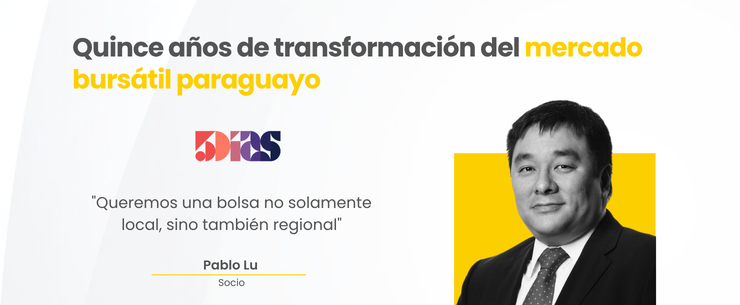
The Paraguayan stock market has undergone a profound transformation over the past fifteen years, evolving from a fledgling, manual system to a more digital, liquid, and diversified market with greater international integration. The evolution of the Asunción Stock Exchange (BVA) reflects the country’s own economic leap forward.
In 2011, the market still exhibited characteristics of an early stage of development. Annual trading volume totaled just US$ 67.6 million, with a total of 2,012 transactions for the entire year. The market structure was heavily concentrated in the primary market, which accounted for nearly 90% of transactions, while the secondary market had a marginal share of just 10%, limiting the system’s liquidity and depth.
The president of the Stock Exchange himself, Pablo Cheng Lu, recalls that moment as a turning point. “In 2011, the Stock Exchange began to take off with the implementation of the electronic trading system,” he noted. The change was no small matter: it involved moving away from a system based on physical records and manual processes to a fully digital platform. “We went from a completely handwritten, paper-based system to a fully electronic one,” he added.
CHALLENGES
From that point on, growth was steady and progressive, though not without challenges. One of the main focuses was expanding the issuer base and building a stock market culture in a country historically oriented toward bank credit. “We had to bring in local companies and convince them to list on the stock exchange, to see that they had a financing alternative—not just traditional bank financing—but also to view the stock market as a place where they could obtain that financing,” explained Cheng Lu.
Fifteen years later, the progress is evident. In 2025, the stock exchange recorded a trading volume of approximately US$ 9.2 million, with 43,081 transactions throughout the year.
But the change is not only quantitative but also structural: the secondary market has firmly taken the lead in the system, reaching approximately US$ 7.84 million, compared to US$ 1.44 million in the primary market. This reversal marks a milestone in the market’s maturation, as it consolidates a more liquid and dynamic market.
INTERNATIONALIZATION
Another important aspect is the growing internationalization of operations. In 2011, the guaraní dominated virtually the entire market, accounting for nearly 90% of transactions. By 2025, transactions in U.S. dollars already accounted for 37.37%, reflecting greater openness and financial sophistication.
This growth is also evident in the diversification of instruments. The Ministry of Economy and Finance established itself as the market’s leading issuer, with a volume of approximately US$ 13,319 million in 2025. Added to this are instruments that were in their infancy or nonexistent just over a decade ago, such as investment funds, which traded around US$ 35.8 million, and currency futures contracts, which are beginning to gain a foothold in the local market.
The most recent milestone in this evolution came in 2026, with the integration of technology provided by NASDAQ. As of January 12, the BVA moved beyond its regional systems to operate on a world-class platform. “The implementation of a platform like NASDAQ’s gave us a much more robust tool,” Cheng Lu noted following the system’s international launch in New York.
OPERATIONAL REORGANIZATION
This development is complemented by an operational reorganization: the Stock Exchange now focuses exclusively on trading, while the settlement of trades has been entrusted to the Caja de Valores del Paraguay (CAVAPY), through international infrastructure. According to the head of the BVA, this will lead to a market that is “much more mature, much more robust, and with greater capacity for growth.”.
The long-term projections are even more ambitious. Today, the stock market is worth approximately 25% of the Gross Domestic Product, but the goal is to reach between 80% and 85% over the next fifteen years. To this end, the strategy aims to transform Asunción into a regional financial hub capable of attracting securities offerings from companies in Brazil, Argentina, Chile, and Bolivia.
“We want a stock market that is not only local but also regional,” said Cheng Lu. The central argument is the country’s macroeconomic stability and its double investment-grade rating, which opens the door to new flows of international capital. With this in mind, the Paraguayan stock market seeks to consolidate its new phase: that of an expanding regional financial player.
Partner at MERSAN
Source: 5Días Paraguay
 Español
  English
  Português do Brasil