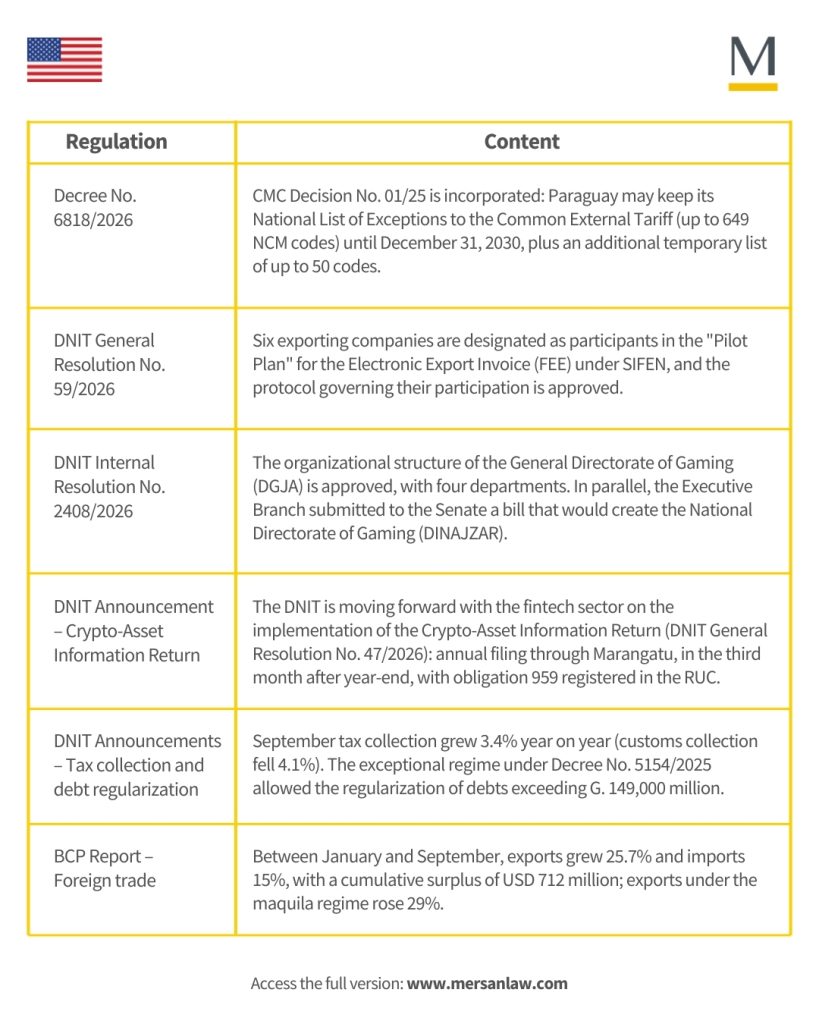

Tax news in October 2026: extension until 2030 of the National List of Exceptions to the Common External Tariff, designation of the six companies for the Export Electronic Invoice Pilot Plan, approval of the structure of the General Directorate of Gambling, export trade report, and DNIT announcements about crypto assets.
► Decree No. 6818/2026 – CMC Decision No. 01/25 is incorporated and the National List of Exceptions to the Common External Tariff is extended until 2030.
By means of Decree No. 6818 of August 31, 2026, the Executive Branch incorporated into the national legal system Decision No. 01/25 of the Common Market Council (“CMC“), which amends CMC Decision No. 58/10 on the national lists of exceptions (“LNE“) to the MERCOSUR Common External Tariff (“AEC“), and repealed Article 2 of Decree No. 6542/2021, since the new decision in turn repeals CMC Decision No. 11/21.
CMC Decision No. 01/25 authorizes each State Party to keep an LNE to the AEC: Paraguay may keep up to 649 codes of the MERCOSUR Common Nomenclature (“NCM“) until December 31, 2030 (Argentina and Brazil, 100 codes until 2028; Uruguay, 225 codes until 2029). In addition, each State Party may keep a temporary LNE, “for adaptation to the new international context,” of up to 50 additional NCM codes, with the same deadline for Paraguay. Under this temporary list, the tariff reduction applies only if exports from another State Party to the country that includes the product do not reach 20% of that State Party’s total exports of the relevant NCM code (in FOB value, on average over the last three years), and the products may not be concentrated in more than 30% of the codes of any single NCM chapter. Accordingly, the decree also amended Article 4 of Decree No. 6897/2022 to provide that the tariff levels of the goods identified with the abbreviation “LNE” in the national tariff schedule will remain in force until December 31, 2030.
For importers, the rule provides predictability: the reduced tariffs on goods included in the LNE are extended until the end of 2030, and the door is opened to adding up to 50 additional tariff lines with reduced tariffs, the composition of which must be set by decree. That process is worth following closely, as it is an opportunity to propose the inclusion of inputs or capital goods that currently pay the full AEC.
► DNIT General Resolution No. 59/2026 – Six companies are designated as participants in the “Pilot Plan” for the Electronic Export Invoice (FEE).
By means of DNIT General Resolution No. 59 of October 23, 2026, the DNIT launched the “Pilot Plan” for the implementation of the Electronic Export Invoice (“FEE“) within the National Integrated Electronic Invoicing System (“SIFEN“). The resolution designated six exporting companies as participants (Manufactura de Pilar S.A., O.T.R. Import S.A. Comercial e Industrial, Fujikura Automotive Paraguay S.A., Farmacéutica Paraguaya S.A., COFCO International Paraguay S.A. and Frigorífico Concepción S.A.) and approved, as Annex I, the participation protocol that will govern their rights and obligations. It is issued on the basis of Article 189 of Law No. 125/1991 and Article 46 of Decree No. 872/2023, which empower the DNIT to gradually designate taxpayers as electronic invoice issuers, and it entered into force on the day after its publication.
The plan will be carried out in four stages: (i) contextualization and understanding of the FEE operating model; (ii) development, adaptation, configuration and testing of invoicing systems; (iii) fine-tuning and adjustments based on the companies’ feedback; and (iv) issuance of the FEE in the production environment. The protocol makes clear that participation does not grant any differentiated treatment or tax benefit, that the companies bear the costs of adapting their systems, that documents issued in the test environment have no tax effect, and that the FEE issued in production, once approved by SIFEN, will have the nature of an electronic tax document (“DTE“) valid for all tax purposes and as support for export transactions before the competent authorities. The DNIT’s Executive Management will coordinate the plan, and the DNIT may exclude companies that fail to comply with the protocol.
For all other exporters nothing changes for now: in its announcement of October 28, the DNIT clarified that the issuance and documentation of export invoices continue under the conditions currently in force. However, experience with electronic invoicing (General Resolution No. 105/2021 and DNIT General Resolutions No. 21/2024 and 52/2026) indicates that, once the pilot stage is completed, the DNIT proceeds with mandatory designations by groups. Exporting companies would do well to review now the integration between their invoicing systems, their customs clearances and SIFEN, since the FEE is precisely intended to link the invoice to the customs export transaction, which will foreseeably affect the review of exporters’ refund claims for value added tax (“VAT“) credits.
► DNIT Internal Resolution No. 2408/2026 – The organizational structure of the General Directorate of Gaming is approved.
On October 15, the DNIT announced that, by Internal Resolution No. 2408 of October 6, 2026, it approved the organizational structure of the General Directorate of Gaming (“DGJA“). This directorate was created by Decree No. 3846/2025, which regulates Law No. 7438/2025, the law that amended Law No. 1016/1997 and incorporated the National Gaming Commission (“CONAJZAR“) as a deconcentrated body of the DNIT. The resolution expands DNIT Internal Resolution No. 367/2024 (as amended by No. 1730/2025) and has the favorable opinion of the National Economic Team and of the Vice Ministry of Human Capital and Organizational Management of the Ministry of Economy and Finance (“MEF“).
The new structure comprises four departments: (a) Gaming Control and Enforcement; (b) Gaming Technical and Regulatory Affairs; (c) Gaming Concessions; and (d) Legal Advisory. A six-month deadline was set for preparing the job description and position profile manuals; until then, the units will be governed by the table of functions in Annex II of the resolution. In practice, the DGJA is the unit with which gaming operators and concessionaires must deal on matters of concessions, control and enforcement. Within that same framework, the DNIT is already exercising the power conferred on it by Law No. 7438/2025 to ratify the gaming rules approved by CONAJZAR: for example, through DNIT General Resolutions No. 57 and 58 of September 18, 2026, it ratified the “quiniela” lottery rules of two concessionaires.
This reorganization coincides with a regulatory change in the making: on October 12, a bill from the Executive Branch, submitted by the MEF, entered the Senate that would create the National Directorate of Gaming (“DINAJZAR“) as an autonomous body, replacing CONAJZAR, and would repeal Law No. 1016/1997. The bill was referred to committees on October 14 and must still complete the full legislative process, so that, for the time being, the regime of Law No. 7438/2025 and Decree No. 3846/2025 remains fully in force.
► DNIT Announcement – Progress in the implementation of the Crypto-Asset Information Return.
On October 5, the DNIT announced that it held a technical meeting with representatives of the fintech sector to move forward with the implementation of the Crypto-Asset Information Return (“DJI“) created by DNIT General Resolution No. 47/2026, and to prepare a cooperation agreement with that sector. At the meeting, the technical aspects of the resolution were analyzed and information was exchanged on the types of transactions, records and data sources available, with the aim of facilitating the application of the rule.
It should be recalled that General Resolution 47/2026 requires the DJI to be filed (a) by the owners, administrators or persons responsible for crypto-asset platforms operating in the country, and (b) by individuals, legal entities and other entities resident or incorporated in Paraguay whose annual crypto-asset transactions exceed USD 5,000, when they operate through non-resident platforms or without the intermediation of any platform. The DNIT confirmed that the DJI will be filed annually through the Marangatu System, in the third month after the close of the fiscal year being reported, and that those required to file must have obligation 959 registered in the RUC. For taxpayers with a December 31 year-end, the first return will correspond to fiscal year 2026 and will be due in March 2027, according to the filing calendar; late filing is penalized with a fine of G. 1,000,000. Those who have not yet requested the inclusion of obligation 959 in the RUC should do so as soon as possible, since late updating of RUC data also gives rise to a fine for contravention.
► DNIT Announcements – September tax collection and results of the exceptional debt regularization regime.
According to the report published by the DNIT on October 1, cash tax collection in September 2026 amounted to G. 3,944,399 million (USD 676.1 million), 3.4% more than in September 2025. The General Management of Internal Taxes (“GGII“) grew 8.2%, driven mainly by the Corporate Income Tax (“IRE“), while the General Management of Customs fell 4.1%, because the appreciation of the guaraní (20% in September) reduced the local-currency tax base of imports. For the January–September period, collection totaled G. 32,877,249 million (+2.3%), with internal taxes up 10.2% and customs taxes down 9.1%.
In addition, on October 16 the DNIT reported the results of the exceptional and temporary tax debt regularization regime under Decree No. 5154/2025, which was in effect from late December 2025 until August 31, 2026: debts of G. 149,265 million were regularized, through 2,442 payment facilities (installment plans) and 129 lump-sum payments. 52% of the amount corresponded to debts in judicial collection and 48% to administrative debts; by segment, small taxpayers accounted for 68% of the regularized amount, medium-sized taxpayers for 20% and large taxpayers for 12%. With the regime now over, outstanding debts return to the ordinary treatment: a late-payment surcharge of 1.5% per month (Decree No. 10.768/2013) or payment facilities at the 1.4% monthly rate set by Decree No. 6478/2026.
► BCP Report – Foreign trade through September 2026.
The Foreign Trade Report of the Central Bank of Paraguay (“BCP“), published on October 13, shows that between January and September 2026 total exports reached USD 15,972.6 million (+25.7% year on year) and imports USD 15,260.6 million (+15%), with a cumulative surplus of USD 712 million, slightly below the August figure (USD 716.9 million). Registered exports totaled USD 10,223.4 million (+19.7%), re-exports USD 3,989.3 million (+18.7%) and “other exports” USD 1,759.8 million (+117.5%).
Growth continues to be explained by the soybean complex: beans (USD 3,107.2 million, +45.1%), oil (USD 591.7 million) and meal (USD 565.3 million), while beef and bovine offal fell 5.3% (USD 1,536 million) and parboiled rice 6.6% (USD 262.1 million). Exports under the maquila regime reached USD 1,149.3 million, 29% more than in the same period of 2025. On the purchasing side, registered imports accounted for 98% of the total (USD 14,949.1 million, +15.5%).